|
|
| Line 38: |
Line 38: |
|
| |
|
|
| |
|
| Exercise
| |
|
| |
|
| * Go to the [http://141.2.159.95:7002/wt/ Online Grammar 2] with the gap above.
| |
| * Parse the following strings:
| |
| ** him Lilly likes (choose solution 1)
| |
| ** him Lilly spoke to (choose solution 3)
| |
| ** to him Lilly spoke (choose solution 4)
| |
|
| |
| * Parse the following strings:
| |
| ** he Lilly likes (choose solution 1)
| |
| ** he Lilly spoke to (choose solution 1)
| |
|
| |
|
| |
| ** Lilly gave the apple to him
| |
| ** to him Lilly gave the apple (choose solution 4)
| |
|
| |
| ** Lilly gave the apple at him
| |
| ** at him Lilly gave the apple (choose solution 4)
| |
|
| |
|
| |
|
| |
|
| |
|
| |
|
| |
|
| |
|
| |
| <span style="color: blue>'''Exercise:'''</span>
| |
|
| |
| * Parse all the sentences below and see whether you find a pattern in the data:
| |
|
| |
| (1) <br>
| |
| a. Lilly likes Fido.<br>
| |
| b. Fido, Lilly likes __.
| |
|
| |
| (2) <br>
| |
| a. Lilly depends on Fido.<br>
| |
| b. Fido, Lilly depends on __.
| |
|
| |
| (3) <br>
| |
| a. Lilly depends on Fido.<br>
| |
| b. On Fido, Lilly depends __.
| |
|
| |
| (4) <br>
| |
| a. Lilly is fond of Fido.<br>
| |
| b. Fido, Lilly is fond of __.
| |
|
| |
| (5) <br>
| |
| a. Lilly showed me a picture of Fido.<br>
| |
| b. Fido, Lilly showed me a picture of __.
| |
|
| |
| (6) <br>
| |
| a. Lilly said I like Fido.<br>
| |
| b. Fido, Lilly said I like __.
| |
|
| |
| (7) <br>
| |
| a. Lilly said I claimed she likes Fido.<br>
| |
| b. Fido, Lilly said I claimed she likes __.
| |
|
| |
| Because preposing can in principle span arbitrarily many clauses, it is one example of a long distance dependency!
| |
|
| |
| (8) * Fido, Lilly smokes __.<br>
| |
| (9) * To Fido, Lilly likes __.<br>
| |
| (10) * She, Lilly likes __.<br>
| |
| (11) * To Fido, Lilly depends __.<br>
| |
| (12) * Fido, Lilly claims __ am sad.<br>
| |
|
| |
| (1) <span style="color: blue>What pattern do (1)-(12) show?</span>
| |
| <div class="toccolours mw-collapsible mw-collapsed" style="width:800px">
| |
| Check your answer
| |
| <div class="mw-collapsible-content">
| |
| An expression can be preposed from a position P if and only if it can occur in position P.
| |
| </div>
| |
| </div><br>
| |
|
| |
|
| We distinguish between two kinds of phrases: | | We distinguish between two kinds of phrases: |
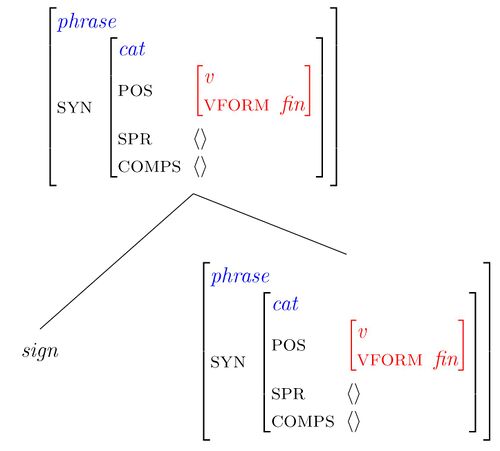
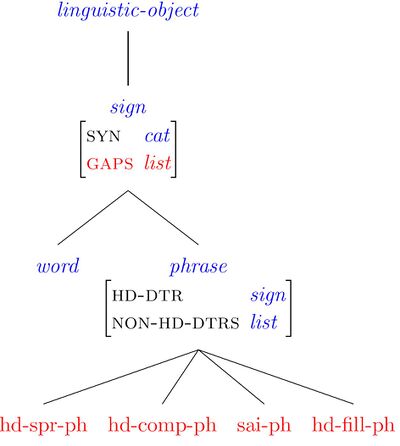
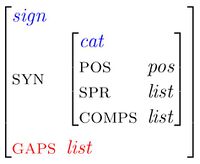
Introducing the GAPS feature
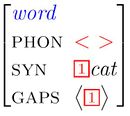
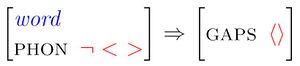
The Gap Collection Constraint

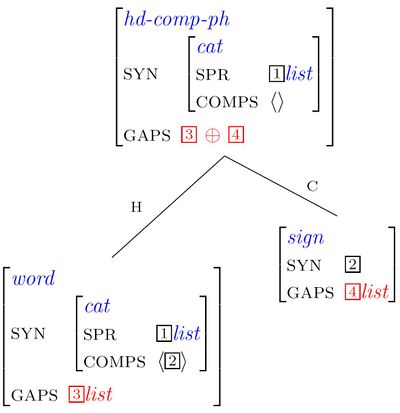
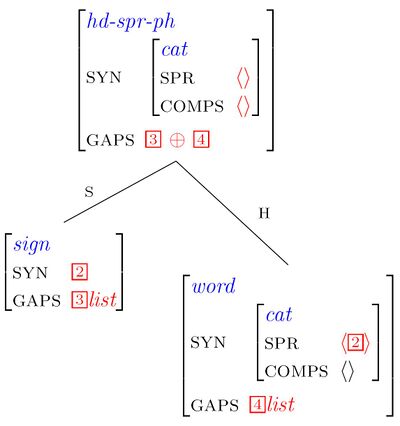
Illustrating the Gap Collection Constraint
The Head-filler schema
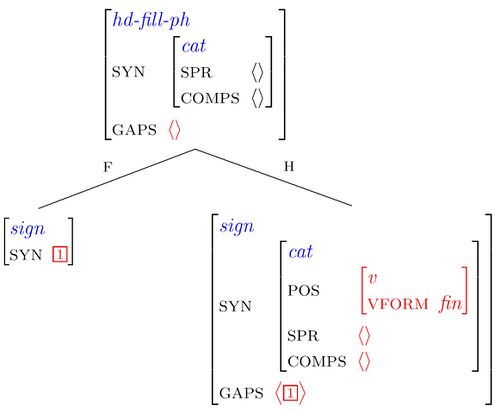
We distinguish between two kinds of phrases:
1. Stand(ard) phrases: hd-comp-ph, hd-spr-ph, hd-c-ph, sai-ph
2. Head-Filler phrases: top-ph, question
Remarks:
1. ⊕ is the list merger operator. (to merge = verschmelzen)
2. L1 ⊕ L2 is the new list L3 which contains all the elements of list L1 followed by all the elements of list L2.
Examples:
1. <> ⊕ < a > = < a >
2. < a > ⊕ <> = < a >
3. < a, a > ⊕ < a, b, c > = < a, a, a, b, c >


