2019 is the International Year of Indigenous Languages (IYIL). World-wide, many initiatives use this occasion to raise awareness for indigenous langauges, their importance, the threats that they are facing, and their chances. Continue reading International Year of Indigenous Languages: Events at the IEAS
Sailer at Modification of Complex Predicates, Düsseldorf
Manfred Sailer gave an invited talk at the workshop on Modification of Complex Predicates, Düsseldorf, 23.&24.5.2019. The workshop was organized jointly by a number of projects of the SFB 991: The structure of representations in language, cognition, and science.
The workshop organizers, Curtis Anderson, Timm Lichte, and Jens Fleischhauer aimed at bringing together researchers on various kinds of complex predicates and at jointly discussing to which extend modification data can help shed light on the properties of complex predicates. The 10 workshop presentations illuminated exactly these aspects using different types of data and analytical tools. In his own talk, Manfred looked at modified kinegrams as in (1).
(1) Alex pricked her big ears. Continue reading Sailer at Modification of Complex Predicates, Düsseldorf
Niko Schenk Contributes to Beta Writer
In early April the international and German press and other media reported on the publication of the first software-generated scientific book, a volume which summarizes state of the art research on lithium-ion batteries and appeared with Springer Nature. One of the creators of Beta Writer, the software behind the book, is Niko Schenk, who works and teaches linguistics at IEAS and is simultaneously affiliated with the Applied Computational Linguistics Lab in the computer science department. We linguists at IEAS are all very excited about his work and its impact!
If you are interested in the technology and in the challenges posed by the automatic generation of research books, the introduction to the freely available electronic version of the book gives an overview on the ongoing research in this area.
Frankfurt Summer School: Linguistics
This year’s Frankfurt Summer School (5.8.-30.8.) offers a 4-weeks course package in research methods in linguistics.
The modules are open to all interested students. They are particularly useful for students of disciplines in which language plays an essential role, such as linguistics, philology, literary studies, media studies, gender studies, ethnology, (foreign) language teaching etc.
The lecturers are: Gerald Penn (Toronto), Janina Radó (Frankfurt a.M.), Frank Richter (Frankfurt a.M.), Iverina Ivanova (Frankfurt a.M.), and Ulrike Schneider (Mainz)
Module 1: Basic Research Methods in Linguistics (weeks 1 and 2, 05.08.–15.08.)
Language is an essential feature ofall humans that distinguishes us from all other known species. The study of human languages is not Continue reading Frankfurt Summer School: Linguistics
englicious: Material for teaching English grammar
The Survey of English Usage project of University College London has been creating resources for teaching English. The web site englicious.org is of particular interest for future teachers of English. It is freely accessible and contains material to explain and practice English grammar, based on the UK National Curriculum of 2014. Continue reading englicious: Material for teaching English grammar
Monica Rizea back in Frankfurt!
We are happy to welcome Monica-Mihaela Rizea (Bucharest) back in Frankfurt!
Monica is staying at our department from January 1 to March 31, 2019, as a DAAD fellow with her project “On the Distribution of Negative Polarity Minimizer Expressions. A Collocational and Reading-dependent Account.”
In the project, Monica plans to carry out an analysis of the Continue reading Monica Rizea back in Frankfurt!
IEAS/Linguistics Christmas Gathering 2018
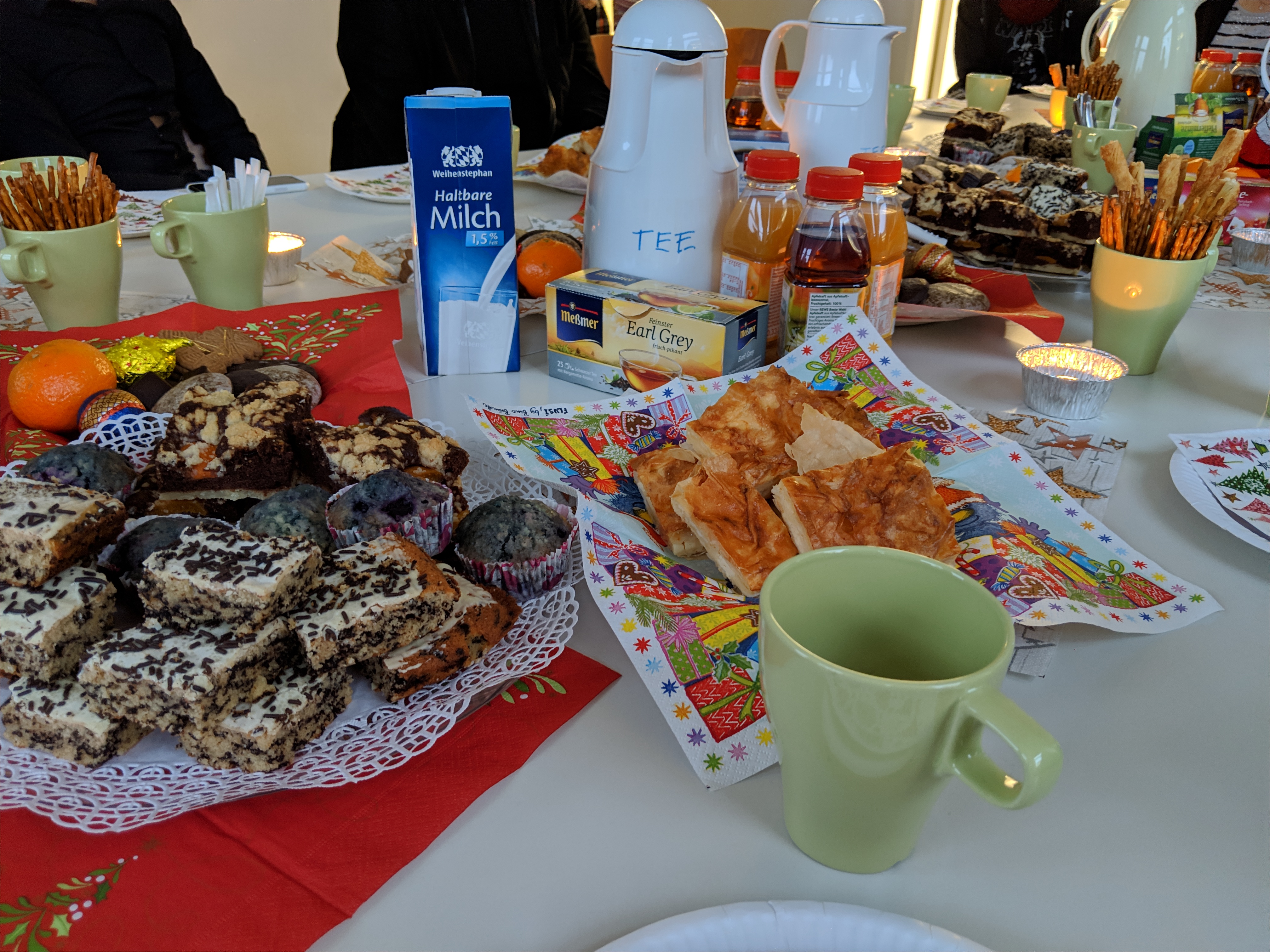
Monday, December 17, we had the traditional Christmas Gathering of the English linguistics group. There was plenty of delicious home-made!) food and we all remembered many nice things that happened or that we had acchieved in 2018.
Happy holidays and the best for 2019 to everyone in the department and to everyone reading this post!
Call for papers: REEL Day 2019 “Digital Data in English Linguistics”
CALL FOR PAPERS
REsearch in English Linguistics
(REEL Day 2019)
Digital data in English linguistics:
Lexical and functional uses of verbs
Mainz, 16.2.2019, 9am – 6pm
Organizers: Ulrike Schneider (Mainz) & Manfred Sailer (Frankfurt)
Keynote: Bas Aarts (UCL)
Webpage: https://www.english-linguistics.de/digital-data-in-english-linguistics-2019/
We would like to invite students (BA, MA, Lehramt) from Goethe University to submit proposals for posters and/or short presentations (20 minutes + 10 minutes discussion) to the first joint Mainz-Frankfurt student workshop on Digital Data in English Linguistics. Continue reading Call for papers: REEL Day 2019 “Digital Data in English Linguistics”
Webelhuth et al in “Reconstruction effects in relative clauses”
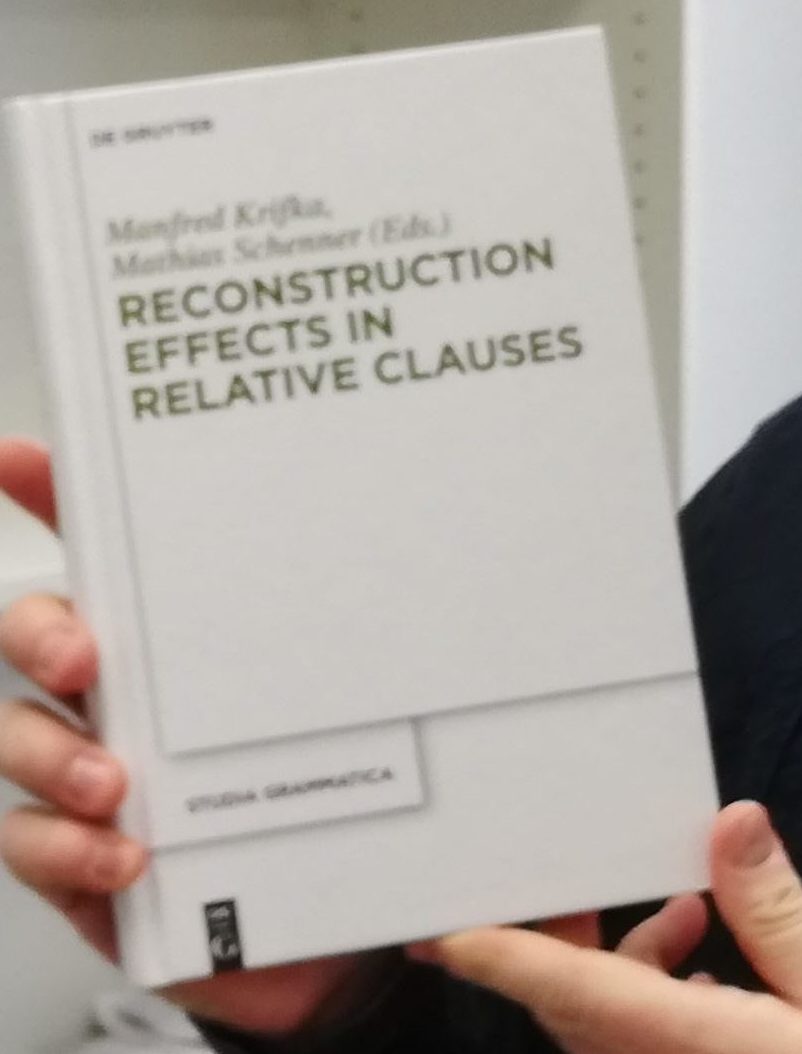
Gert Webelhuth, Sascha Barmann, & Christopher Götze have just published a paper on “Idioms as evidence for the proper analysis of relative clauses” in a volume on Reconstruction effects in relative clauses.
The authors provide evidence against a raising analysis of relative clauses and show that the data on idioms in relative clauses can be captured elegantly in a modification analysis. Among many other highlights, the paper presents the first formal account of anaphoric relations to idiom parts across sentence boundaries.
Continue reading Webelhuth et al in “Reconstruction effects in relative clauses”
Crysmann on Apparent Reversal in Old French Declension
November 19 & 20, Berthold Crysmann (Paris) visited Frankfurt to give two talks on his joint work with Alain Kihm on Apparent reversal in Old French declension. Berthold and Alain argue that even though the Old French declension looks like a case of reversal, it should better be described in terms of generalizations over various declension classes.
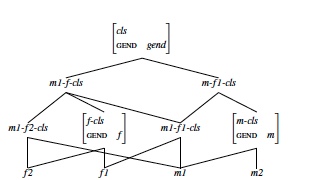
Berthold’s visit was funded as part of the Paris-Frankfurt network One-to-Many Correspondences in Morphology, Syntax, and Semantics (2017 & 2018). Continue reading Crysmann on Apparent Reversal in Old French Declension